Acrylic and polycarbonate
Acrylic scratches easily, and can almost never be replaced.
Aquariums, boats, display cases, signage and car headlights. Same crew, different compound.
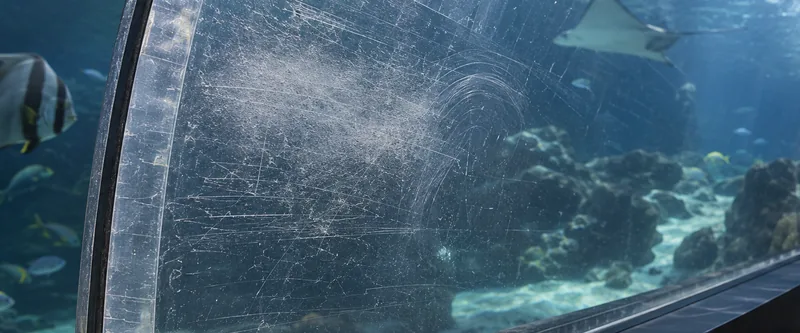
Why it scratches so easily
- The material. Acrylic is softer than glass: what leaves no mark on a glass panel does leave one on acrylic.
- Polycarbonate. It marks even more easily than acrylic: a small particle is enough.
- Daily cleaning. A dry rag, dirty water and grit, every day, on the same face. That is what does most of the scratching.
Why replacing the piece is almost never an option
- The aquarium. It is not a loose sheet: large panels are chemically bonded to each other, and you don’t take one out.
- Curved pieces. Tunnels, boat windows and signage are formed for that spot: they don’t come off a shelf.
- The headlight. It is that car’s part and no other car’s, with its own price and its own import time.
Clouded headlights — the same line, already on its own page ›
What we do
Same crew, different compound: the system is the one we use on glass and what changes is the formula. The scratching and the haze come out without replacing the piece, and the work happens wherever the aquarium, the case or the car is.
The three materials we treat ›
How the result is checked ›
What we don’t treat
- Broken or cracked acrylic or polycarbonate — that one does need replacing.
- Very deep scratches close to an edge or a bonded joint.
Saying so up front beats a promise we can’t keep.
Price and timing
Both come down to the condition of the piece and where it is. We don’t post a number we can’t hold to: send us a photo and we’ll answer both, and whether it can be brought back or the piece has to be replaced.